Skip to content

Anywhere Deposit Fraud

Multi-Layered Check Deposit Fraud Detection:

Detecting Counterfeits, Forgeries, and Alterations From Any Deposit Channel

Solution Overview: Anywhere Deposit Fraud

Anywhere Deposit Fraud is a sophisticated OrboAnywhere Module, developed specifically to identify fraudulent checks deposited in any deposit channel, most typically at the bank of first (BoFD). Anywhere Deposit Fraud utilizes a sophisticated multi-layer approach which can be integrated into existing fraud platforms, or run independently. In both cases, the module will significantly reduce deposit fraud charge-offs and modernize the environment by scoring items and transactions so funds are not immediately available for access by the fraudster.

Anywhere Deposit Fraud Use Cases

The most common types of deposit fraud at banks involving checks include:

Bank teller reviewing check for deposit, highlighting fraud detection in banking.

Scammers create fake checks that appear legitimate, often mimicking personal, business, cashier’s, or official bank checks. These checks are deposited, and victims are tricked into sending funds back to the scammer (e.g., via wire transfer, gift cards, or cryptocurrency) before the bank detects the fraud, leaving the account holder liable for the funds. Advanced printing technologies make these checks hard to detect, even for bank employees.

Checks deposited at the BoFD which are fraudulent can be considered either first or 3rd party fraud. In the case of first party fraud, the account holder making the deposit is actually the perpetrator. In the case of third party fraud, the account holder is potentially not involved in the fraudulent transaction, and is merely a conduit to getting the money in or out of the check payment system of the FI.

Fraudulent deposited checks can be very difficult to detect, even with the many solutions available on the market. Why? The majority of these checks are drawn off other financial institutions (FIs). Because there is no immediate verification available at the item level, FIs are reliant on Reg CC funds availability rules, various account monitoring tools, or blended consortium data sources to manage risk of deposits. These systems are very vendor dependent, and many are outdated for today's complex multi-channel deposit processing.

Digital illustration of a bank building connected to an ATM, mobile device, and a digital interface, representing advanced check deposit fraud detection and banking technology integration.

To effectively detect check fraud attempts involving a wide range of tactics and use cases, Anywhere Deposit Fraud employs a sophisticated combination of seven (7) fraud detection layers of technology. These layers combine to deliver a best-in-breed check fraud detection solution. The system also generates hundreds of data attributes, which can be utilized in downstream business intelligence and data analytics systems.

Multi-layer Deposit Fraud Detection
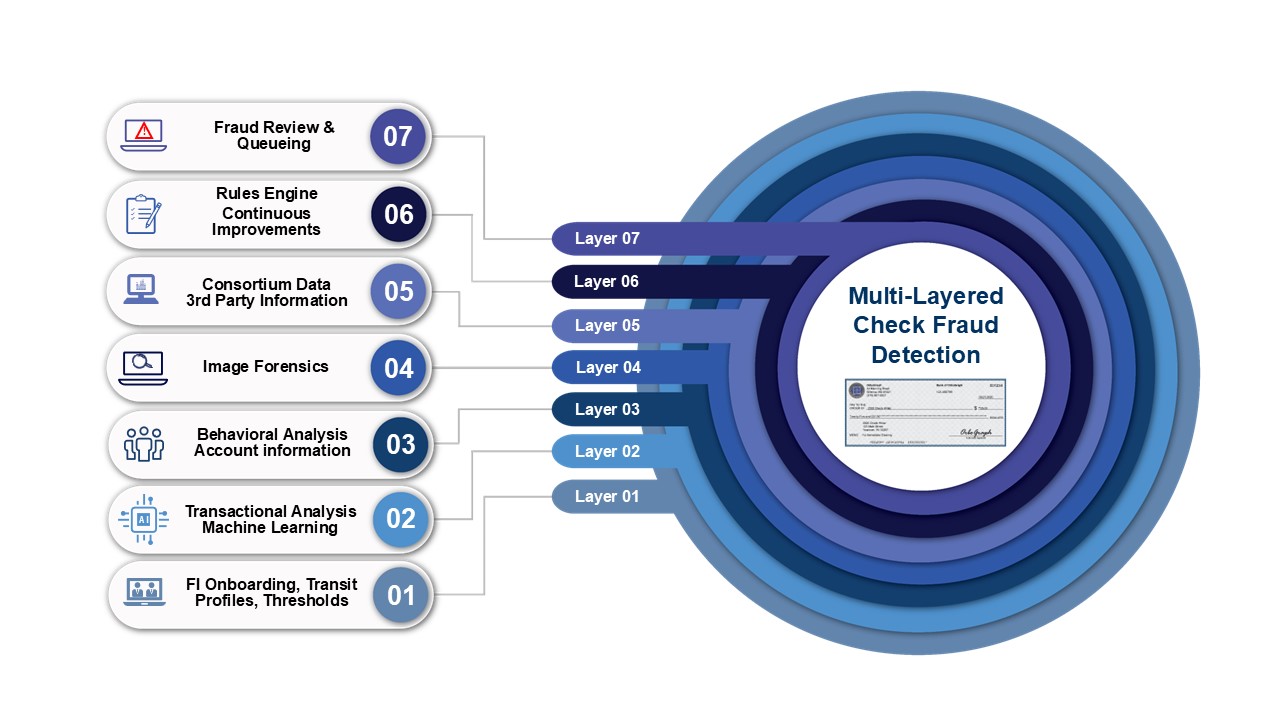
OrboGraph's multi-layered technology framework is a strategic approach that integrates distinct, specialized technologies to deliver exceptional accuracy and performance. Each layer is designed with dedicated analyzers, enabling precision yet flexible scoring to complex fraud use cases. By combining these layers, the system generates a highly accurate composite score. For instance, while a fraudulent item may evade detection in one layer, subsequent layers enhance the likelihood of identification, ensuring robust and reliable outcomes.
Deposit Fraud Layers

Layer 1: Infrastructure, Profiles, & Thresholds

Developing a robust multi-layered technologyapproach for deposit fraud detection starts with a solid foundational infrastructure. For financial institutions, this foundation is not merely a technical requirement but a critical element that ensures seamless integration and functionality of all components involved.
Components of this layer include: multi-tenant database, workflow databases, system APIs, Deposit Profile Editor for threshold management, tuning, automated management, self learning profiles, deposit fraud rules engine, and data import(s) tools. 
Account profiles are very important to monitoring account level transactions. Profiles can start broad, or optimized into specific account types. For example, a general business profile may cover standard commercial checking accounts, while a small business profile enables finely tuned parameters for this customer type. Profiles can be tuned to the account level as well, in the event a specific account has a unique fraud behavior. By establishing a well-designed infrastructure, institutions can guarantee that information flows efficiently and that riskscores are accurately calculated, paving the way for a more reliable detection system.
Woman working on a computer with dual monitors displaying code and data analytics, set against a high-tech background, illustrating advanced technology in fraud detection for banking.

Profiles can also include 3rd party complementary data. This information is imported into the system via batch processes or by API calls, and complements the data base at the account level. Examples include account balance, average daily balance, account status, and risk scores.

Once these profiles are created, financial institutionscan set precise thresholds, employing both transactional and imageforensicanalyzers to pinpoint potential fraudmore effectively. This careful calibration of thresholds significantly mitigates the number of false positives, allowing institutions to safeguard their operations while minimizing unnecessary disruptions to legitimate bank accountactivities.

Layer 2: Outlier - Focused Transactional Analysis

Hand interacting with digital analytics interface displaying data visualizations, graphs, and world map, illustrating advanced fraud detection technology for banking transactions.
Transactional Analysisplays a crucial role in detecting depositfraudby meticulously examining an account's transactions and depositactivities. This layer involves the application of sophisticated statistical analyzer models designed to identify anomalies that could indicate fraudulentactivity.

Anywhere Deposit Fraud Layer 2 transactional analyzers target dollar amount and velocity activities over daily, weekly, monthly and quarterly timeframes. Other analyzers look for unusual deposit timing, duplicates, and other unique scenarios. Analyzers are combined using harmonic mean aggregation as a way to incorporate anomalistic behaviors. The result is a score that most accurately predicts deposit fraud at the item level in real-time.

Scoring of this layer is then used by the system's self-learning logic to build account-level insights. Layers 4 and 5 are complementary to this process, as targeted imageanalyzers are blended with transactional characteristics of each account. 
Note that depending on how an FI decides to deploy with multiple vendors, this layer of functionality can be fulfilled with a 3rd party vendor. In many cases, machine learning-oriented systems currently provide this layer of functionality. The Anywhere Deposit Fraud analyzers can either be used to complement the existing system, or the aggregator can choose to by-pass these results.  

Layer 3: Behavioral Analysis / Account Status

Behavioral analysis serves as another input in understanding and mitigating risks associated with financialtransactions by importing indicators and dataattributes connected to individual accounts. This approach enables financial institutionsto score depositsby utilizing informationsuch as account riskscores and status indicators, such as new, closed, or dormant. Additionally, balance information can contribute to the account health and identify potential risks associated to each check transaction. 
For financial institutionsalready employing effective transaction analysis systems, the behavioral analysis layer may be viewed as optional. Existing systems may provide a robust framework for evaluating transaction authenticity, allowing institutions to maintain their operational integrity and securitymeasures. However, the integration of the behavioral analysis of Anywhere DepositFraud, can offer a complementary safeguard that enhances the overall efficacy of riskdetection. By supplementing existing tools with behavioral insights, financial institutionscan create a more holistic view of account behavior, ultimately leading to better fraud preventionstrategies and improved customer trust.
Business professional analyzing behavioral analytics data on a computer screen, showcasing artificial intelligence insights and transaction analysis for fraud detection in banking.

Layer 4: Image Forensics

Digital check featuring detailed fields including payee information, amount, and memo, set against a circuit-like background, illustrating advanced check fraud detection technology.

Image forensics has evolved significantly in recent years. This layer utilizes the latest deep learning image processing models developed by OrboGraph's OrbNet AI Innovation Lab. Anywhere Deposit Fraud leverages this comprehensive suite of image processing analyzers as Layer 4.

Layer 4 essentially analyzes the entire check and applies a variety of optimized image processing models. This is unique to Anywhere Deposit Fraud, as few solutions use image data today in deposit detection. Forensic analyzer examples include:

  • Check Stock Validation (CSV-AI) for counterfeit detection
  • Automated Signature Verification (ASV-AI) for forgery detection
  • Writer Verification (WV-AI) for alteration detection
  • Payee recognition and account holder name validation
  • Full check image validation and negotiability assessment
  • IQA analysis
  • Amount field recognition, CAR/LAR discrepancy and amount verification

Other fields utilized include: payor/maker, MICR, serial, endorsement, and date fields. All data can be used for positive matching based on previously cleared checks and negative matching compared to previous fraud items.

Layer 5: Check And Account Consortium Data

Consortium datais a powerful component for depositfraud detection. By leveraging frauddatafrom multiple financial institutions or internal data sources, consortiums provide real-time insights into fraudpatterns, including stolen checks, altered items, and fraudulent accounts. This shared intelligence allows banks to identify risky depositsfaster and more accuratelythan relying solely on transactional specific data.

Anywhere Deposit Fraud provides consortium enablement for financial institutions, service bureaus, bankers banks, associations, and business partners, as well as correspondent banks and other aggregators. By doing so, this strategy enables data sharing and collaboration within consortium nodes. An optional consortium approach allows for integration with third-party consortium providers like AFS but can also connect multiple consortium clusters. The combination delivers a solution which provides the widest market coverage compared to a single data resource.

Internal Consortium

Interconnected digital banks representing consortium collaboration for fraud detection in financial services, highlighting a networked approach to check deposit security.

OrboGraph's consortium strategy is to provide an open consortium model. The concept of an open consortium builds on multiple positive and negative data sets from various providers following the concepts of open banking. There are several consortium connectors and options available with the system today.  They include:

An internal consortium utilizes transit profiling as a unique OrboGraph component enabling banks to build out profiles of previously deposited transit checks. with a comparison to previously cleared items, this method facilitates the early identification of potentially fraudulent transactions.

Consortium Connectors

As part of the "open consortium strategy", the system can connect to multiple consortiums including Advanced Fraud Solutions TrueChecks®, EWS, Valid Systems, stolen check databases from the dark web or Telegram,internal cybersecurity datafeeds, behavioral analytics, or output from existing positive and negative lists.
For example, Consortium Connector #1 retrieves account and item level datain real-time including indicators of counterfeit, non-sufficient funds (NSF), closed accounts, duplicates, and other fraudhistory-related activity. These riskscores are blended into the composite scoring and used in the fraudreview platform for returns.
Looking ahead, initiatives such as the American Bankers Association (ABA) National CheckVerification System (NCVS) aim to establish a more expansive and collaborative environment for combating check fraud, fostering a united front among banks against this pervasive threat. OrboGraph is actively involved in this, as well as several initiatives in Canada. 

Layer 6: Rules Engine, Rules Creation, Continuous Improvement

Digital interface with checklists, documents, and analytics graphs, illustrating fraud detection and review processes in financial technology.
Rules enginesserve as a pivotal tool in this battle against fraudulent activities, allowing FIs to tailor their detection around specific use cases and scenarios. Each financialentity encounters unique risks, which necessitate the implementation of custom rules. The true strength of a rules engine lies in its flexibility, enabling institutions to formulate precise parameters with a focus on minimizing false positives. By utilizing Anywhere DepositFrauds embedded rules engine, financial institutionscan leverage an expansive array of dataattributes to refine their detection strategies, ensuring that genuine customer transactions are not mistakenly flagged while enhancing the identification of fraudulent ones.
OrboGraph's Continuous Improvement Process (CIP) is a program which further leverages the capabilities of rules engines by adjusting scores produced within current systems as a way to streamline the detection process. Tools to help generate rules create precise rules which can have ratios of even 1 to 3. 
Note that this layer can be an optional for deployment. When large organizations leverage enterprise rules systems, the Anywhere Deposit Fraud output may flow into the existing rules system. Otherwise, the client may leverage the Orbograph tool for a very select rule set based on limited OrboGraph data attributes.

Layer 7: Fraud Review/Queues Companions & History

The goal of an efficient fraud review platform is to limit the number of false positives and streamline the functions of a fraud analyst.  Equipped with the right tools and access to comprehensive data, these professionals are instrumental in deciphering complex fraudpatterns and making informed decisions on potential threats.
To be most effective in their roles, fraudanalysts require supporting information in the user interface. A robust check fraudreview should includequeues to assess high fraud probability items as well as historical accountdataand companion images. Recognizing this need, Anywhere DepositFraudhas been developed as an integrated solution that enhances existing check fraud review platforms. Furthermore, the incorporation of Explainable AI (XAI) offers analysts insights into the rationale behind each fraudalert, enriching their investigative process. This combination of technologyand expert analysis not only streamlines operations but also bolsters the overall defense against check fraud, ultimately safeguarding customer trust and financialassets.
Woman analyzing check fraud review on computer screen, featuring check details and fraud analysis platform interface, emphasizing financial fraud prevention technology.

Anywhere Deposit Fraud Deployment

Futuristic user interface displaying fraud prevention analytics, including graphs, data visualizations, and security icons, emphasizing advanced technology for check fraud detection.

Anywhere Deposit Fraud module runs independently or as a scoring engine to an existing infrastructure, supporting low, medium, and high volume clients. All modules can run on the same hardware, or can be partitioned depending on the processing windows, volumes, and real-time versus batch requirements of the client(s).

The Anywhere Deposit Fraud module is designed to support real-time requests, providing access to any deposit channel while the transition is in process. Batch processing during day 1 or day 2 can also be implemented. In most installations, real-time and batch coexist, due to complexities in getting deposit data and images from various deposit channels immediately.

Click the button below to schedule a discussion with one of our check fraud detection experts.