Solution Overview: Anywhere Deposit Fraud
Anywhere Deposit Fraud is a sophisticated OrboAnywhere Module, developed specifically to identify fraudulent checks deposited in any deposit channel, most typically at the bank of first (BoFD). Anywhere Deposit Fraud utilizes a sophisticated multi-layer approach which can be integrated into existing fraud platforms, or run independently. In both cases, the module will significantly reduce deposit fraud charge-offs and modernize the environment by scoring items and transactions so funds are not immediately available for access by the fraudster.
Anywhere Deposit Fraud Use Cases
The most common types of deposit fraud at banks involving checks include:

Scammers create fake checks that appear legitimate, often mimicking personal, business, cashier’s, or official bank checks. These checks are deposited, and victims are tricked into sending funds back to the scammer (e.g., via wire transfer, gift cards, or cryptocurrency) before the bank detects the fraud, leaving the account holder liable for the funds. Advanced printing technologies make these checks hard to detect, even for bank employees.
Checks deposited at the BoFD which are fraudulent can be considered either first or 3rd party fraud. In the case of first party fraud, the account holder making the deposit is actually the perpetrator. In the case of third party fraud, the account holder is potentially not involved in the fraudulent transaction, and is merely a conduit to getting the money in or out of the check payment system of the FI.
Fraudulent deposited checks can be very difficult to detect, even with the many solutions available on the market. Why? The majority of these checks are drawn off other financial institutions (FIs). Because there is no immediate verification available at the item level, FIs are reliant on Reg CC funds availability rules, various account monitoring tools, or blended consortium data sources to manage risk of deposits. These systems are very vendor dependent, and many are outdated for today's complex multi-channel deposit processing.

To effectively detect check fraud attempts involving a wide range of tactics and use cases, Anywhere Deposit Fraud employs a sophisticated combination of seven (7) fraud detection layers of technology. These layers combine to deliver a best-in-breed check fraud detection solution. The system also generates hundreds of data attributes, which can be utilized in downstream business intelligence and data analytics systems.
Multi-layer Deposit Fraud Detection
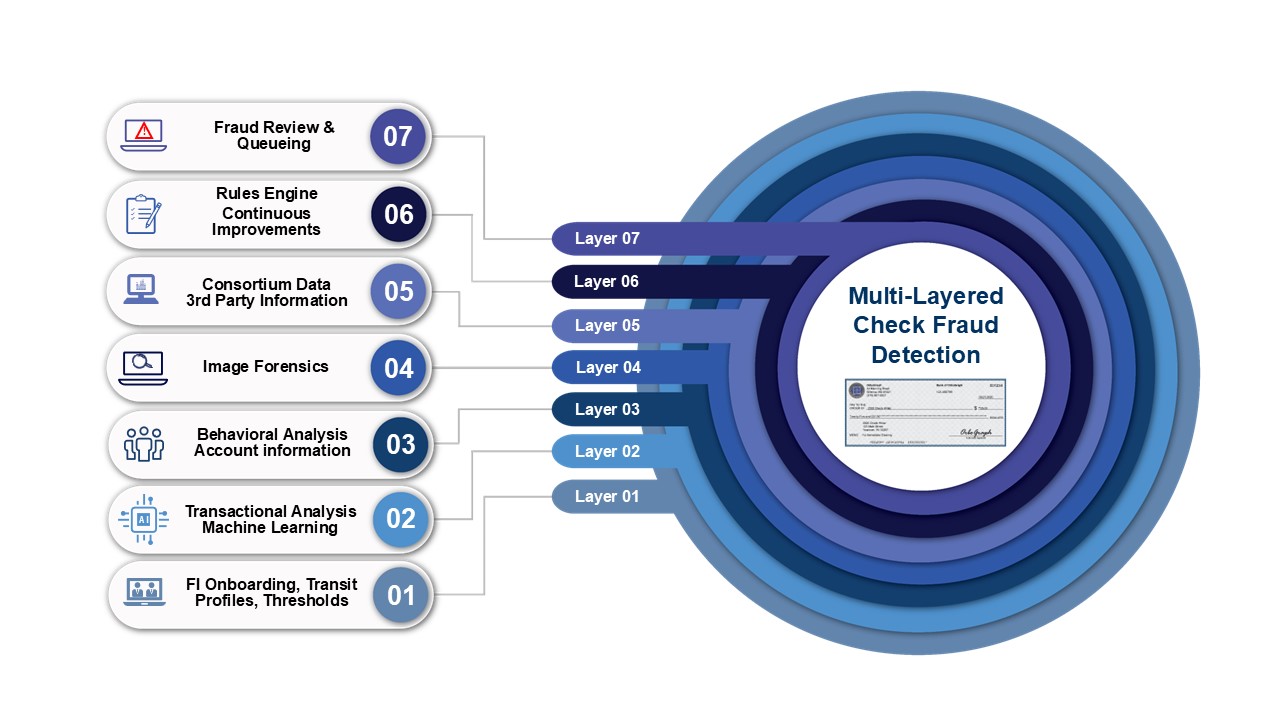
Layer 1: Infrastructure, Profiles, & Thresholds

Profiles can also include 3rd party complementary data. This information is imported into the system via batch processes or by API calls, and complements the data base at the account level. Examples include account balance, average daily balance, account status, and risk scores.
Layer 2: Outlier - Focused Transactional Analysis

Anywhere Deposit Fraud Layer 2 transactional analyzers target dollar amount and velocity activities over daily, weekly, monthly and quarterly timeframes. Other analyzers look for unusual deposit timing, duplicates, and other unique scenarios. Analyzers are combined using harmonic mean aggregation as a way to incorporate anomalistic behaviors. The result is a score that most accurately predicts deposit fraud at the item level in real-time.
Layer 3: Behavioral Analysis / Account Status

Layer 4: Image Forensics

Image forensics has evolved significantly in recent years. This layer utilizes the latest deep learning image processing models developed by OrboGraph's OrbNet AI Innovation Lab. Anywhere Deposit Fraud leverages this comprehensive suite of image processing analyzers as Layer 4.
Layer 4 essentially analyzes the entire check and applies a variety of optimized image processing models. This is unique to Anywhere Deposit Fraud, as few solutions use image data today in deposit detection. Forensic analyzer examples include:
- Check Stock Validation (CSV-AI) for counterfeit detection
- Automated Signature Verification (ASV-AI) for forgery detection
- Writer Verification (WV-AI) for alteration detection
- Payee recognition and account holder name validation
- Full check image validation and negotiability assessment
- IQA analysis
- Amount field recognition, CAR/LAR discrepancy and amount verification
Other fields utilized include: payor/maker, MICR, serial, endorsement, and date fields. All data can be used for positive matching based on previously cleared checks and negative matching compared to previous fraud items.
Layer 5: Check And Account Consortium Data
Consortium data is a powerful component for deposit fraud detection. By leveraging fraud data from multiple financial institutions or internal data sources, consortiums provide real-time insights into fraud patterns, including stolen checks, altered items, and fraudulent accounts. This shared intelligence allows banks to identify risky deposits faster and more accurately than relying solely on transactional specific data.
Internal Consortium

OrboGraph's consortium strategy is to provide an open consortium model. The concept of an open consortium builds on multiple positive and negative data sets from various providers following the concepts of open banking. There are several consortium connectors and options available with the system today. They include:
Consortium Connectors
Layer 6: Rules Engine, Rules Creation, Continuous Improvement

Layer 7: Fraud Review/Queues Companions & History

Anywhere Deposit Fraud Deployment

Anywhere Deposit Fraud module runs independently or as a scoring engine to an existing infrastructure, supporting low, medium, and high volume clients. All modules can run on the same hardware, or can be partitioned depending on the processing windows, volumes, and real-time versus batch requirements of the client(s).
The Anywhere Deposit Fraud module is designed to support real-time requests, providing access to any deposit channel while the transition is in process. Batch processing during day 1 or day 2 can also be implemented. In most installations, real-time and batch coexist, due to complexities in getting deposit data and images from various deposit channels immediately.
Click the button below to schedule a discussion with one of our check fraud detection experts.