SEON Report: The Value of AI in Fraud and AML Increasing
- SEON survey shows 98% of organizations already embed AI in fraud, AML workflows
- Budgets for AI-driven fraud and AML tools are rising, but systems remain fragmented
- AI augments fraud and AML teams, automating volume while humans handle complex investigations
In the recently published report entitled AI Reality Check, 2026 Fraud & AML Leaders Report, SEON --a prominent fraud and AML platform -- underscores the pivotal role of artificial intelligence (AI) in revolutionizing fraud prevention and anti-money laundering (AML) operations. With 98% of organizations already integrating AI into their workflows, AI has become a foundational element in combating fraud.

The report surveyed 1,010 fraud, risk, and compliance leaders from organizations within the global betting and gaming, payments. fintech, financial services & online leading, retail and compliance industries.
Key Findings: Investments in AI
According to research from SEON, 83% of organizations expect their fraud and AML budgets to increase in 2026—a clear signal that investment in AI-driven risk management is accelerating, not slowing down. Most institutions have already deployed AI in some capacity, but the data shows they are now planning to expand its reach into additional workflows and decision points.
However, the numbers also reveal a structural problem. While 95% of organizations report some level of integration between fraud and AML workflows, only 47% operate on fully integrated platform workflows. That means more than half are still relying on partially connected systems—creating operational friction, duplicative reviews, inconsistent risk scoring, and costly blind spots.
The visibility gap is even more telling. 80% of organizations say obtaining a unified view across fraud and AML systems is at least somewhat challenging, and over 40% describe it as extremely or very challenging. This fragmentation directly undermines AI performance, limits data quality, and reduces operational efficiency. In short, while budgets are rising and AI adoption is expanding, true integration—and the measurable performance gains it should deliver—remains out of reach for many institutions.
Enhancing -- NOT Replacing -- Fraud and AML Teams
We noted previously the role AI plays in check processing and check fraud, enhancing capabilities and not replacing humans. The report provides details that validate this approach.
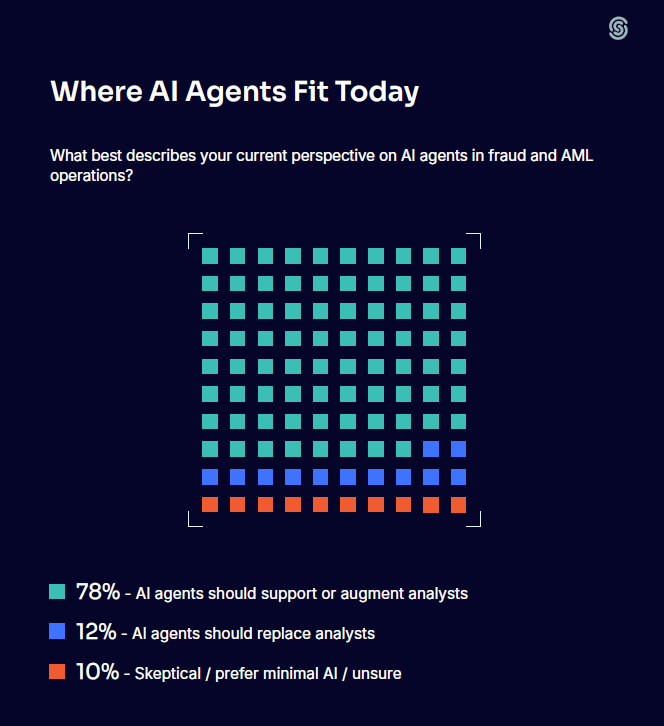
The research notes that AI is being deployed as an augmentation tool—not a replacement for human expertise. More than 85% of fraud and AML leaders believe AI agents should act as copilots that support analysts, while only 12% believe AI will eventually replace them. The data shows that organizations view AI primarily as a way to scale human decision-making rather than eliminate it.
This shift is also changing how fraud and AML teams spend their time. As automation absorbs high-volume tasks such as transaction monitoring, anomaly detection, and alert summarization, human analysts are moving up the value chain. Increasingly, teams are focusing on complex investigations, model oversight, regulatory reporting, and cross-functional risk strategy—areas where human judgment and contextual understanding remain essential.
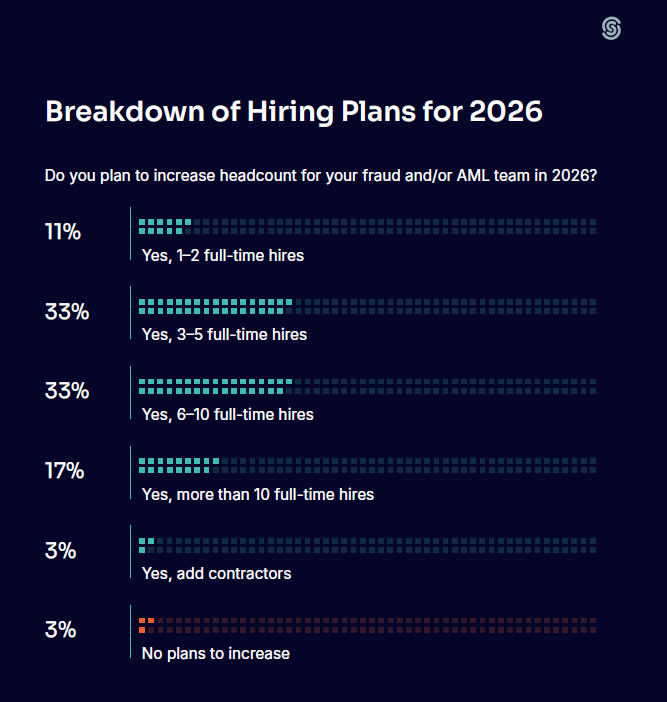
At the same time, AI adoption is not reducing hiring—it is accelerating it. According to the survey:
- 94% of leaders plan to add at least one full-time fraud or AML professional in 2026, up from 88% the previous year
- 33% expect to add 3–5 employees
- 33% plan to hire 6–10
- 17% anticipate expanding their teams by more than 10 roles
Taken together, the data illustrates a clear trend: AI tools are becoming deeply embedded within fraud and AML workflows, dramatically reducing manual workloads and improving efficiency. Yet human expertise remains indispensable. Automation can process volume and surface anomalies, but analysts are still required to interpret edge cases, refine detection models, and ensure compliance with constantly evolving regulations.
Staying Ahead of the Threat
The future of fraud and AML teams -- this year and beyond -- will see the most successful institutions deploying AI technologies to increase the effectiveness of their teams, not replace them.
As noted by SEON:
AI now runs through almost every fraud and AML program, yet leaders still add personnel, increase budgets and struggle with fragmented systems. The old assumption — that automation would simplify operations — no longer holds.
This aligns with check fraud detection for both on-us and deposit fraud as AI‑driven systems and explainable (XAI) are used to analyze check images, historical behavior, and transaction activity to flag suspicious items. Instead of drowning in false positives, fraud analysts receive prioritized alerts and transparent risk explanations, enabling faster, more confident decisions and better use of their expertise.

And, while 80% of leaders experience at least some difficulty achieving a single view for a unified fraud & AML data view, these technologies -- while can be used as stand alone -- can be integrated with other fraud solutions to provide the financial institutions with a more holistic view of the fraud landscape.