RTP Adoption Hindered by Fear of Fraud
-
Fraud fears are slowing real-time payment adoption despite lower actual fraud rates.
-
Most RTP fraud incidents are minor, thanks to modern detection systems.
-
Advanced AI tools are making RTP safer and boosting confidence in adoption.
Widespread anxiety about fraud is hindering the full-scale adoption of real-time payments (RTP) in the U.S., according to a recent analysis by PYMNTS.
Many financial institutions (FIs), especially large banks, limit their participation in real-time networks to receive-only service, citing fears that fraud will surge as payment speed increases. In fact, 85% of payment professionals surveyed expect fraud rates to rise as RTP usage expands.
However, are their fears largely misplaced?
Data from PYMNTS and industry surveys reveal that actual fraud rates on real-time rails like RTP and FedNow are substantially lower than on legacy payment systems. In 2024, 63% of U.S. firms reported check fraud, compared to only 2% reporting fraud connected to RTP or FedNow. For example, just 123 fraudulent events occurred out of 35 million RTP transactions analyzed in April 2025—a rate far below other payment types.

Impact of Fraud: Real-Time Payments vs. Checks
When examining the impact of the different types of fraud, we can see a clear difference felt by the financial institutions.
Moreover, the severity of fraud’s impact on faster payments is often limited. According to the Faster Payments Barometer, just 3% of financial institutions report real-time payments’ fraud impact as “significant.” Most incidents are categorized as “slight” or “moderate,” and a large portion of FIs report zero impact. These findings suggest that current controls are working, though sustained investment is still needed to stay ahead of evolving threats.
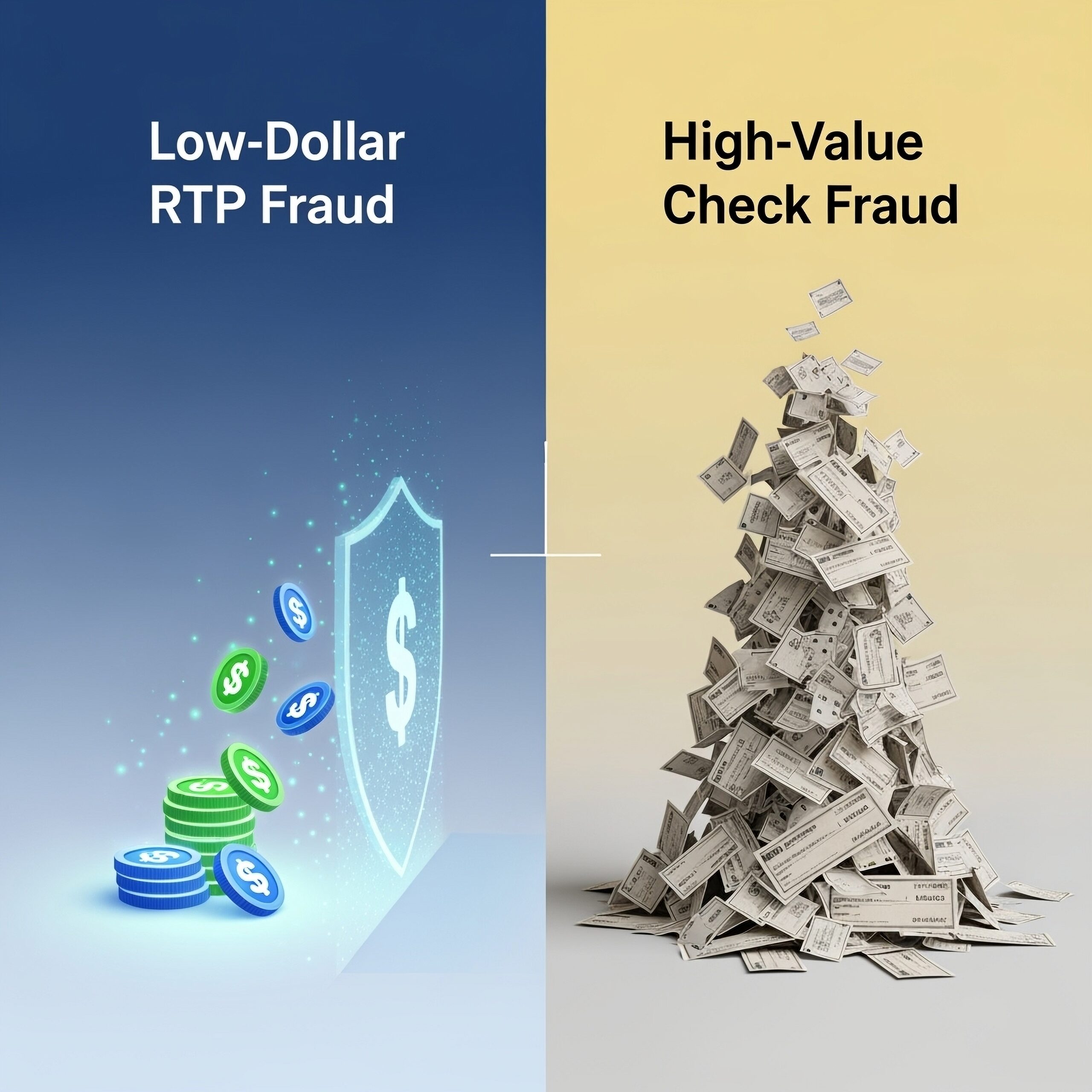
What the report does not explain is a major factor that would contradict the "controls are working" theory: the value of the fraud incident. While concrete numbers of the amount lost per incident are not known, many suggest that RTP fraud incidents are purposefully low amounts in order to bypass controls. For checks, the numbers suggest average losses of tens of thousands. The smaller amounts could correlate to lower "impact."
Additionally, RTP represents a lower opportunity cost for fraudsters. There are only so many times a fraudster can target a single account before the system is able to identify a pattern. This is much different than checks, where a single stolen check can produce hundreds of counterfeits for thousands of dollars.
Increased Confidence in Technology
Advanced technologies—such as artificial intelligence, real-time detection, multifactor authentication, and industry-supported ID verification —are seeing widespread adoption and support from banks. In the UK, such ID tools have cut fraud by 60%, and 96% of U.S. banks favor similar measures.

RedCompass Labs asked U.S. banks which fraud prevention measures they consider most urgent. Leading the list: artificial intelligence (AI) and machine learning (ML) (40%), followed by real-time detection (39%) and multifactor authentication (MFA) (35%). Data sharing among banks (32%) and coordination with telecom and tech firms (27%) round out the top five.
Additionally, 54% of U.S. big banks this year believe AI can improve financial crime detection. This holds true for check fraud detection, as many banks are leveraging AI technologies like OrbNet Forensic AI for On-Us and Deposit Fraud Detection. These technologies analyze check payments, identifying 95% of counterfeits, forgeries, and alterations.
While pundits will continue to push for larger scale adoption of new payment rails, fraud is ubiquitous. Rather than focus on each payment, fraud should be viewed holistically to ensure that the FI is protecting itself and its entire customer base.