Federal Reserve Report: No Major Fraud Category is Declining
- Federal Reserve report finds no major fraud category dip; debit cards and checks lead attempts.
- Faster payments saw sharpest year-over-year rise in attempted fraud and associated losses.
- Banks boost fraud budgets with layered tech defenses, yet threats continue outpacing controls.
On April 28, 2026, the Federal Reserve published its Financial Services Risk Officer Survey. The major theme the report: No major fraud category is declining.
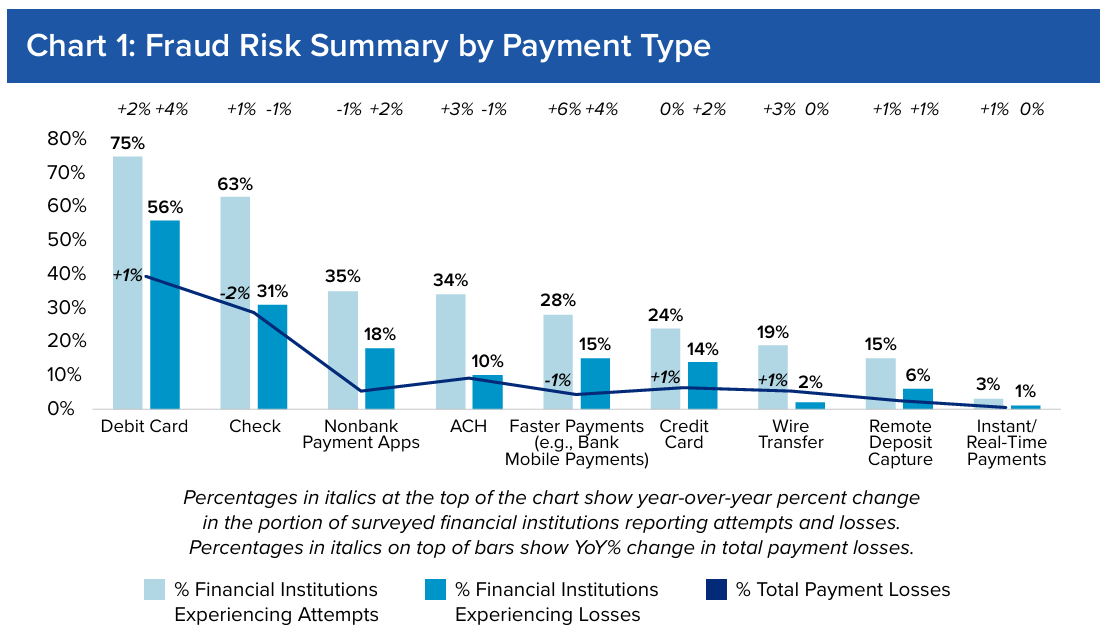
The report notes that surveyed financial institutions most often cited debit cards (75%) and checks (63%) as the primary sources of fraud attempts and losses. Meanwhile, faster payments—such as mobile banking transactions—are emerging as a growing risk, showing the largest year-over-year increase in both attempted fraud and associated losses. Despite these shifts, the overall distribution of fraud losses by payment type has remained relatively consistent over the past three years, with only modest fluctuations across individual categories.
Focusing on Check Fraud
The report notes that check fraud remained the second most-frequently reported type of fraud; 63% of surveyed financial institutions reported experiencing check fraud attempts, and 31% of those divulged they had losses from it.
Additionally, the report reveals the following:
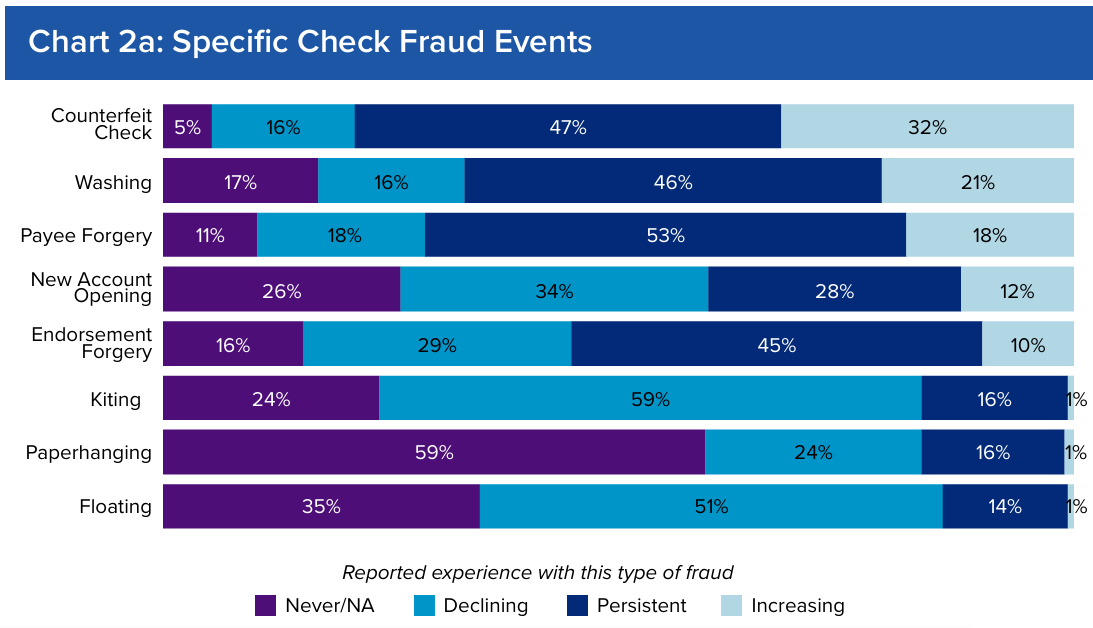
- 32% of financial institutions reported increases in counterfeiting
- 83% reported check washing, with 21% cited increases
- 89% of respondents indicated that they experienced payee forgery, with 18% documenting increases in payee forgery
- 3% more financial institutions noted that new account opening fraud was persistent or increasing compared to last year
Technology is Needed to Fight Back Against Fraud
The report cites the following being utilized by FIs to fight back:
- AI image analysis/image forensics to detect alterations and anomalies
- Positive Pay, including payee name verification, to stop unauthorized checks from clearing
- Manual reviews and staff training to catch fraud
- Advance monitoring for new account transactions
Furthermore, PYMNTS.com notes that according to their The 2025 State of Fraud and Financial Crime report, 68% of institutions increased fraud detection spending, reflecting a shift toward AI-driven and behavioral analytics-based approaches. However, even with the increase in spending, PYMNTS.com goes on to point out that "effective mitigation requires coordination across systems, channels and institutions, as well as alignment between detection tools and operational processes."
Many financial institutions have adopted a multi-layered technology framework to enhance fraud detection, especially for checks. As a check item progresses through these layers, even if it passes one level, subsequent layers can re-examine the image and flag any concerns for further review, providing robust protection against fraud.