USPS OIG Spring 2026 Report: Is the Postal Service Hiding Its Inability to Stop Fraud?
- OIG’s Spring 2026 report shows USPIS barely using its powerful civil fraud tools.
- Postal Police staffing has been gutted since 2020, even as organized mail theft has surged.
- Banks must assume mail is unsafe and lean on layered, technology-driven check fraud defenses.
For years, OrboGraph has tracked a troubling pattern in USPS mail security failures. We've covered the audit that found 143 missing arrow keys in Sacramento post offices, the nationwide audit of 84 facilities where 76 had untracked or unsecured arrow keys, and the USPS's own damning report on its new eLock program — where 12,000 units sat uninstalled, USPS canceled a planned second batch of 50,000, and 20% of carrier scanning devices were simply unaccounted for.
Most recently, we wrote about the May 2026 OIG Audit Report (No. 25-147-R26), where the Postal Inspection Service did not effectively oversee the VRAT process.
Specifically, auditors found:
- Many surveys were not started or incomplete
- Deficiencies remained unresolved
- The status of resolved deficiencies was not reported in the system
- Not all facility management received required VRAT security training prior to performing surveys
- Personnel from both the Postal Inspection Service and USPS duplicated efforts by completing separate VRAT surveys at the same Tier 1 and Tier 2 facilities in the same fiscal year
The picture those audits painted was of an agency unable to secure the mail. The USPS OIG Spring 2026 Semiannual Report to Congress suggests something worse: the agency appears to be hiding something from the public.
Is the USPS Hiding the Data to Reduce Scrutiny?
Frank Albergo, National President of the Postal Police Officers Association, reviewed the report and pulled no punches. He noted that the U.S. Postal Inspection Service has powerful civil tools under 39 U.S.C. §§ 3005 and 3007 — false-representation proceedings, consent agreements, cease-and-desist orders, and mail detention orders — designed to stop fraud before the damage is done.
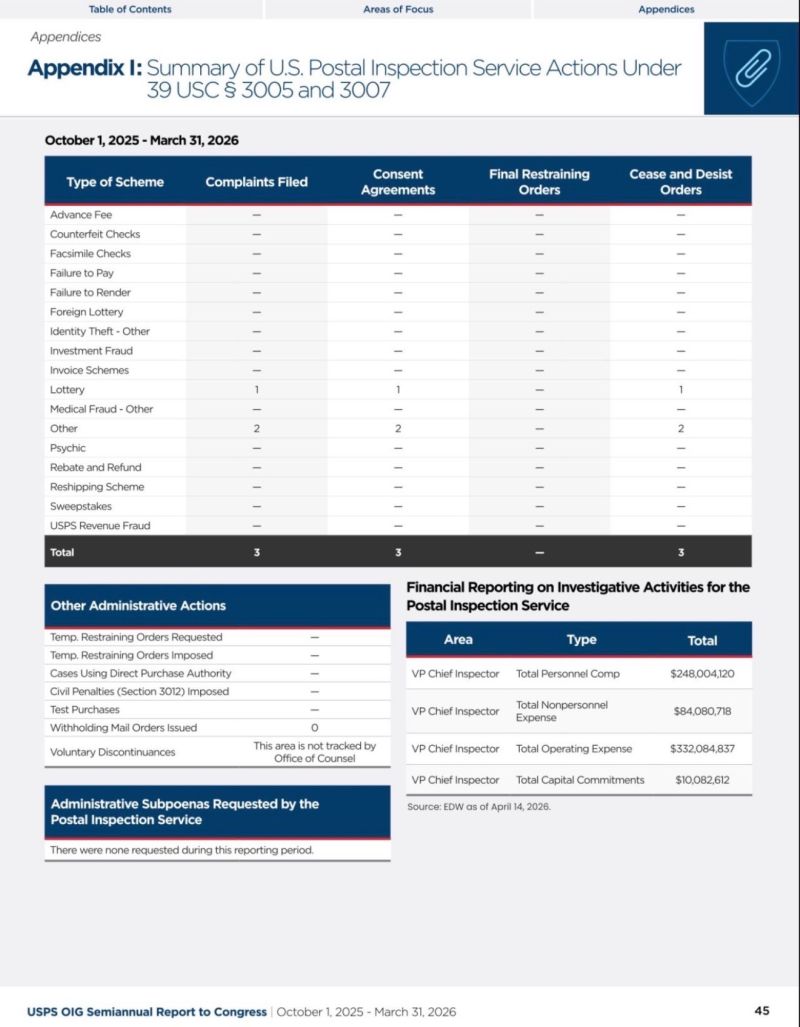
Here's what those tools came up with over the entire six-month reporting period (October 1, 2025 to March 31, 2026):
- 3 complaints filed
- 3 consent agreements
- 3 cease-and-desist orders
- 0 final restraining orders
- 0 withholding mail orders issued
- 0 administrative subpoenas requested
You read that correctly -- three complaints in half a year.
But what may be most concerning is the lack of transparency. When we examine the table below, any individual or organization in the industry knows that counterfeit checks are a major issue and the source of these checks are stolen from the mail. Yet, there are no complaints filed? Is the USPS claiming to have zero complaints? Is the process to file the complaints overly complex or nearly impossible to submit? Or, are they hiding the numbers which may lead to increased scrutiny?
Reliance on USPS to Reform Not an Option to Stop Fraud
Albergo goes on to report that the USPIS is spending $580 million annually while relying almost exclusively on criminal investigations that, by definition, happen after stolen checks are already in fraudsters' hands.
As we've noted repeatedly, financial institutions cannot rely on the Postal Service to protect checks in the mail stream. While we agree with Frank Albergo's call to reform the USPS and get more Postal Police in the ranks, this entails a long process that financial institutions simply cannot afford.
Since financial institutions are unable to stop fraudsters from stealing checks, they need to shift focus to deploying technologies that detect fraudulent checks before funds are lost -- whether during the inclearing process or when a check is deposited through any deposit channel.