ABA Survey Confirms Banks are America’s Front Line Against Fraud
- Survey shows consumers overwhelmingly trust banks as their primary fraud defenders
- Respondents want stronger government action forcing social media & telecoms to fight fraud
- Stopping check fraud means banks must pair consumer education with advanced analytics & forensics
A new infographic -- based on research conducted by Morning Consult and published by American Bankers Association -- sends a clear message: Consumers still see banks as their most trusted defense against fraud—far more than any other industry. At a time when check fraud, scams, and payment fraud are accelerating, that trust is both a responsibility and an opportunity for financial institutions and their technology partners.
The survey, based on a national online sample of 4,456 adults fielded February 21–25, 2026, reveals how deeply consumers trust their financial institutions:
- 9 in 10 agree their bank takes proactive steps to protect them from fraud/scams
- 3 in 4 believe their bank does more than businesses in other industries to protect them from fraud/scams
- 3 in 5 received a fraud alert from their bank alerting them to suspicious activity
- 96% found their bank’s fraud alerts valuable
- 60% are concerned with government regulations stopping all messages, including fraud alerts
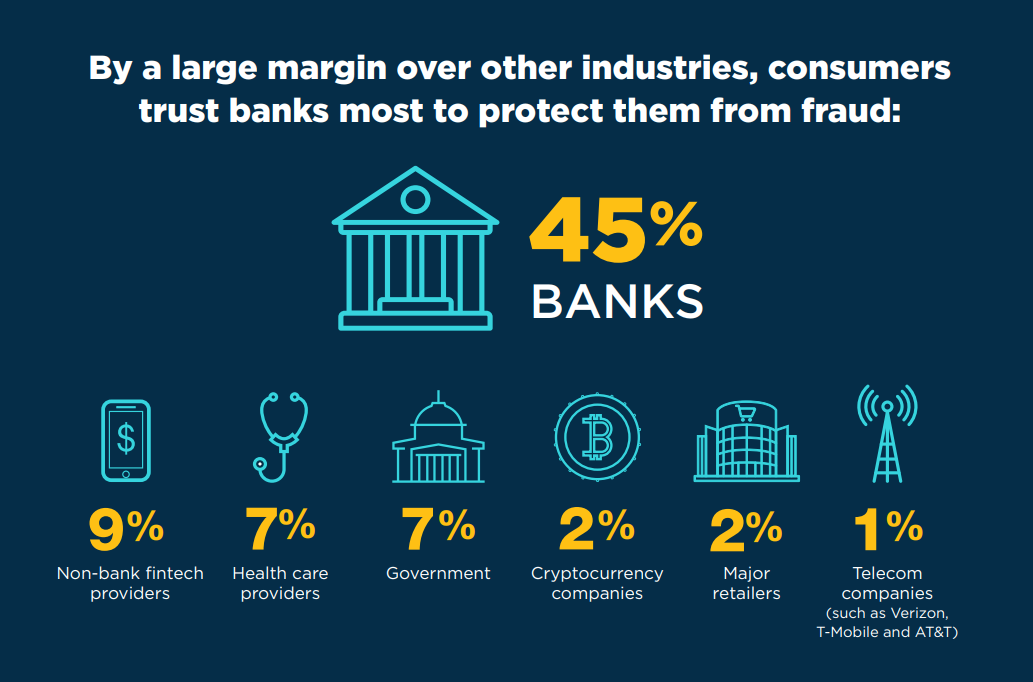
Additionally, when asked who they trust most to protect them from fraud, 45% of respondents choose their financial institution, while only small single-digit percentages select non-bank fintechs, healthcare providers, government, retailers, crypto firms, or telecom companies. In other words, despite rising fraud losses, consumers still look to their bank first when something goes wrong—or when something looks suspicious.
Consumers Want More Government Action
Over the past several years, we've seen the US Government take several steps to address fraud concerns. Most recently, industry banking executives appeared in front of the United States House Committee on Financial Services for a hearing, aptly entitled “Fighting Fraud on the Front Lines: Challenges and Opportunities for Financial Institutions,” to discuss the meteoric rise in cybercrimes and fraud.
According to the survey, consumers support legislation that would further protect them, noting that 76% have seen ads and messages on social media from people and businesses that they believe are fraudulent and deceptive. In response, consumers would support requiring more fraud protection from social media platforms and telecommunications providers:
- 78% would support federal legislation that requires social media companies to do more to identify and stop fake accounts and fraudulent ads from proliferating on their platforms
- 77% would support regulatory action that requires telecommunications providers to do more to authenticate the identity of a caller and prevent spoofed caller ID

Fighting Fraud -- Who You Gonna Call?
When fraud occurs, consumers will reach out to their financial institutions. Subsequently, they will also blame their financial institutions...even if the fault lies with the consumer. Being a victim of fraud is an emotional experience which often leads to lower levels of rationality. Victims will ask, for instance, "how did my bank not stop the transaction?"
So, while financial institutions do a great job reminding their consumers to watch for scams and providing alerts, all will be for naught if they can't actually identify and stop fraud before funds are lost.
That's why many financial institutions are turning to technology in the fight against fraud. You wouldn't expect Dr. Peter Vankman, Egon Spengler, Ray Stanz, and Winston Zeddemore -- the "Ghostbusters" crew -- to neglect using their "proton packs" or "ghost traps" when battling supernatural beings. By the same token, financial institutions shouldn't fight against fraud -- particularly check fraud -- without the right technology on their side, such as transactional analytics, behavioral analytics, image forensics, consortium data, and dark web monitoring.
These technologies, layered on top of each other, provide financial institutions with the defense needed to protect themselves and their consumers against the ghouls of on-us and deposit check fraud.