Artificial Intelligence and Deep Learning

Even as we see our industry create and adopt newer and better, more precise tools for improving check processing and preventing fraud (we proclaimed 2019, remember, the Year of AI and Modernization), it’s important to be aware of how to most effectively integrate new technology the current ecosystem in a manner that maximizes return on investment.
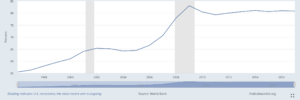
Predicting an economic recovery in today’s COVID-19 environment is far more complex than reading traditional individual economic indicators. As seen by the recent run in the stock market, there are certain market components somewhat disassociated from traditional indicators, i.e. unemployment rate, GDP growth, etc.

In a little over a month, OrboGraph will host the ORBOIMPACT Virtual Conference: AI Innovation for Check Payments, Check Fraud, and Healthcare Remittance Automation.
In a little over a month, OrboGraph will be hosting it’s first virtual conference since 2014: ORBOIMPACT Virtual Conference: AI Innovation for Check Payments, Check Fraud, and Healthcare Remittance Automation.
By now, many of you have heard of the arguments between utilize GPU vs CPU. towardsdatascience.com provides a simple explanation on the reasoning behind the need for GPUs for machine learning:
GPUs are optimized for training artificial intelligence and deep learning models as they can process multiple computations simultaneously.
They have a large number of cores, which allows for better computation of multiple parallel processes. Additionally, computations in deep learning need to handle huge amounts of data — this makes a GPU’s memory bandwidth most suitable.

Pymnts.com explores the various hurdles banks face when taking that big — and increasingly necessary — step. They note that migrating to the cloud is a vital tool traditional financial institutions (FIs’) will need in order to compete with digital-native FinTechs.

To the layman, much of the language in the AI space can be mystifying, particularly in deep learning. Take for example one of the core elements; the node. A deep learning node is “a computational unit that has one or more weighted input connections, a transfer function that combines the inputs in some way, and an output connection. Nodes are then organized into layers to comprise a network.”

Modern bank consumers are more and more comfortable interacting with their accounts online, often from a portable device. It’s never been easier to make deposits — using an app on an always-handy phone — and see the “funds available” right in an account, reassuring the user that the money is indeed deposited and… available. MyBankTracker…

Forbes magazine reports on a recent AI Today podcast wherein Casey Royer of USAA, a large US bank serving the military community, shared information on how the bank is adopting AI, how they’re using AI to broaden USAA banking offerings, make their operations more effective and efficient, and offer greater value to their growing customer…
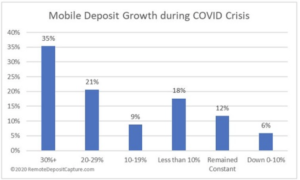
RemoteDepositCapture.com had a hunch that the Covid-19 pandemic would lead to an increase in RDC deposits (Mobile Deposit, Desktop, ATM, etc.). So, in late February, they started polling the industry, asking the following question: For Financial Institutions: What has been the rate of growth or decline in your mobile deposit volume over the past year?…