Uncategorized

In case you missed it, over the past month, we have published incredible content on our OrboNation Blog and Modernizing Omnichannel Check Fraud Detection. Review the latest OrboNation Newsletter online or via PDF download.

Wal-Mart — already equipped with its own credit and debit/prepaid cards — has in recent months partnered with Ribbit Capital to start a fintech. Payments Journal reports that they are also looking at more financial services offerings via a branded all-purpose mobile app. Wal-Mart certainly has the audience to compete with banks. As reported in Barron’s:

Check scammers are well organized A group of online fraud-fighters is helping to ID the bad guys FI’s need to maintain cutting edge fraud detection to protect customers What if you could see a multi-victim, megabucks scam unfold right in front of your eyes? An online fraud fighter known as “Brianna Ware” (“B. Ware” for…

No, this is not a scene from a sci-fi action movie starring the immortal Arnold Schwarzenegger. As far as we know, there is no “Skynet” that has developed an artificial intelligence with the motive of eradicating all human life.

There is no doubt that the pandemic has created opportunities for fraudsters. Atlas VPN reports that cybercrime cost the world more than $1 trillion in 2020, which works out to around 1% of global GDP. Access via online “pirating” to information like email addresses and social security numbers creates opportunities for phishing and other attacks.
The Architecture, Infrastructure, and Operations Booklet is one in a series of booklets that compose the Federal Financial Institutions Examination Council (FFIEC) Information Technology Examination Handbook (IT Handbook), prepared for use by examiners. As described at the FFIEC website: With the publication of this booklet, the FFIEC member agencies replace the “Operations” booklet issued in July 2004.…
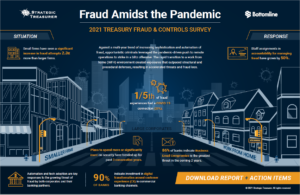
Once again, we see evidence that the COVID pandemic boosted the frequency and sophistication of fraud activity. As tallied in the 2021 Treasury Fraud & Controls Survey by Strategic Treasurer and related by Omri Kletter, global VP for fraud and financial crime at Bottomline, a good deal of fraud is due to the contortions businesses had to make — in a hurry — to accommodate remote work.

Artificial Intelligence can be a dizzying technology to understand. While the term gets tossed around everywhere you turn, it’s important for financial institutions to have a strong baseline of knowledge on the different types of AI, in order to better leverage the technology.
Banks in New Jersey were taken for many thousands of dollars The scam was a fairly elaborate, multi-step affair $250,000 had been stolen before the scammers were caught We all know about scams involving passing fake or altered checks, but what about elaborate multi-step operations? Here’s an interesting “What if?” exercise — could your bank…
Recently, Royal Bank of Canada (RBC) has taken an approach similar to that of OrboGraph’s OrbNet AI Innovation Lab to bring AI technology to the financial industry; partnering with NVIDIA and Red Hat to create Borealis AI. But what is Borealis AI? And what do they do? Well, Borealis AI describes themselves as: A world-class AI research…